Complete Guide, Updated for 2026
ASVAB Study Guide: All 9 Subtests, Scoring, and a Study Plan
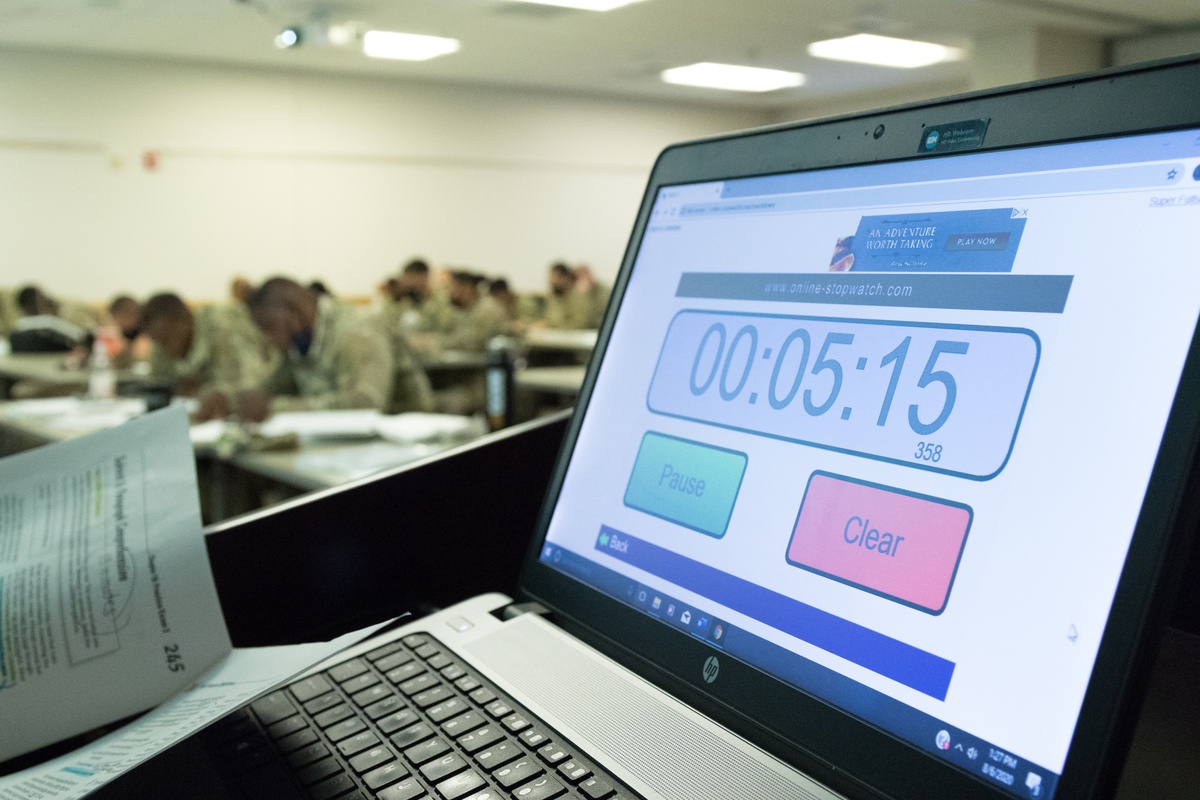
Everything the ASVAB actually tests, what each section is worth, and how to spend your study time so the hours land where the points are. Every tool on this page is free and needs no sign-up.
Why Most ASVAB Study Plans Fail
The number one mistake ASVAB test-takers make? Studying without a target. They buy a prep book, flip to page one, and grind through every chapter equally. Three weeks later they're burned out, they haven't touched the subtests that actually matter for their dream job, and test day is tomorrow.
A good study plan starts with the end: which branch, which jobs, and which scores do you need? Then it works backward to figure out where your time has the highest return. That's exactly what the tools on this page do.
If you're not sure how ASVAB scoring works, read our ASVAB Scores Explained guide first. It covers AFQT, composite scores, and branch minimums with interactive tools. Planning a second attempt? Check the ASVAB retake rules before you build your plan.
What's on the ASVAB: All 9 Subtests
The ASVAB measures aptitude in four domains: Verbal, Math, Science and Technical, and Spatial. Below is every subtest in the order it is administered, with the official question counts and time limits for both versions of the test.
The CAT-ASVAB is the computer version given at MEPS and most MET sites. It adapts to your answers, so it is shorter: about 2 hours on average, with scores available immediately after your session. The paper-and-pencil version is given at a handful of MET sites, runs 225 questions in 149 minutes of testing time, and takes 3 to 4 hours in total once instructions and admin are counted. Results take a few days.
| Subtest | Domain | CAT (Q / min) | Paper (Q / min) | Counts toward |
|---|---|---|---|---|
| GSGeneral Science | Science/Technical | 15 / 12 | 25 / 11 | Line scores |
| ARArithmetic Reasoning | Math | 15 / 55 | 30 / 36 | AFQT + line scores |
| WKWord Knowledge | Verbal | 15 / 9 | 35 / 11 | AFQT (doubled via VE) |
| PCParagraph Comprehension | Verbal | 10 / 27 | 15 / 13 | AFQT (doubled via VE) |
| MKMathematics Knowledge | Math | 15 / 31 | 25 / 24 | AFQT + line scores |
| EIElectronics Information | Science/Technical | 15 / 10 | 20 / 9 | Line scores |
| ASAuto & Shop Information | Science/Technical | 10 / 7 + 10 / 6 | 25 / 11 | Line scores |
| MCMechanical Comprehension | Science/Technical | 15 / 22 | 25 / 19 | Line scores |
| AOAssembling Objects | Spatial | 15 / 18 | 25 / 15 | Line scores |
CAT figures are scored questions and the time limit without tryout questions. Tryout questions are unscored trial items dropped into 2 to 4 subtests at random, and you get extra time when they appear, so your on-screen counts may run higher. On the computer version, Auto Information and Shop Information are administered as two separate subtests and reported as one combined AS score; on paper they are a single subtest. Source: officialasvab.com, What to Expect When You Take the ASVAB. Last verified August 17, 2026.
Read the table this way
Look at AR: 15 questions, 55 minutes on the computer. That is nearly four minutes a question, more time per item than any other subtest by a wide margin. Nobody is trying to rush you through word problems. Now look at WK: 15 questions in 9 minutes, about 36 seconds each. Word Knowledge is not a thinking test, it is a knowing test, which is exactly why flashcards work on it and re-reading does not. The time limits tell you what kind of practice each subtest actually rewards.
Set Your Career Goals
Pick your target branch and up to 3 dream jobs. The tool will analyze the AFQT and composite score requirements, compare them against your self-assessment, and tell you exactly which subtests to prioritize. Your study plan is only as good as your goal, start here.
Pick Your Branch
Know Your 9 Subtests
Same nine subtests as the table above, now with the detail. Click any card to see what it covers, which composites use it, and what to study. Set your career goals in Step 1 first and the cards re-sort by what your target jobs actually need.
The AFQT Formula: Where to Get the Biggest Bang
Your AFQT percentile comes from four subtests using this formula:
AFQT = AR + MK + 2 × VE
VE = 0.655(WK) + 0.406(PC) − 3.03
Notice that VE is doubled. But WK and PC do not feed VE equally: Word Knowledge is weighted more heavily, because the shorter Paragraph Comprehension test is less reliable. Once you work the doubling through, a point of vocabulary (WK) is worth about 1.31 points of raw AFQT, a point of reading comprehension (PC) about 0.81, and a point of AR or MK exactly 1.0. If you're short on time, vocabulary is your highest-leverage study area, and reading comprehension is worth slightly less per point than either math subtest.
Your AFQT is reported as a percentile from 1 to 99, not a percentage. A 50 means you scored as well as or better than 50% of the reference population, not that you got half the questions right. The Department of Defense sorts those percentiles into aptitude categories, and recruiters talk in these categories constantly:
| Category | AFQT percentile | What it means for you |
|---|---|---|
| I | 93-99 | Top of the pool. Effectively every job is open on scores alone. |
| II | 65-92 | Strong. Competitive for technical and clearance-heavy fields. |
| IIIA | 50-64 | The practical target. A 50+ opens most jobs and most bonuses. |
| IIIB | 31-49 | Above every branch floor, but job choice starts narrowing. |
| IVA | 21-30 | Below the enlistment floor. Army's prep-course route starts here. |
| IVB | 16-20 | Below the floor. Retake or a prep course, not a recruiter workaround. |
| IVC | 10-15 | Below the floor. Plan on real study time before retesting. |
| V | 1-9 | Not eligible to enlist. Start from the fundamentals. |
Category bands are from DoD Instruction 1145.01, reproduced in DoD Inspector General report DODIG-2025-092 (2025). The plain-English notes in the right column are ours.
Use our interactive AFQT Formula Explorer to see how changing each subtest affects your percentile in real time.
What to Study for Each Subtest
Below is a study checklist with specific topics for all 9 subtests. Check off topics as you cover them, your progress saves automatically. If you set career goals above, the subtests are sorted by priority for your target jobs.
Track Your Study Progress
Study Progress
0 of 79 topics completed
The 4 AFQT Subtests (Study These First)
ARArithmetic Reasoning
Word problems testing real-world math. You'll see rate/distance problems, percentage calculations, ratio questions, and basic algebra. The key skill isn't math itself, it's translating English sentences into equations.
Use the 3-Step Method on every word problem: WANT (what the question asks for), HAVE (the numbers and facts given), CONNECT (pick the formula that bridges them). Five formulas cover ~80% of AR: Distance = Rate × Time, Percent = (Part / Whole) × 100, cross-multiplication, area formulas, and Average = Sum / Count. See our AR tips guide for worked examples of each.
CAT-ASVAB: 15 questions · 55 minutes · Feeds AFQT + most branch composites
WKWord Knowledge2x VE
Vocabulary, pick the word closest in meaning. This subtest is pure memorization. Learn 10 new words per day using flashcards with root words, prefixes, and suffixes. Focus on Latin/Greek roots (bene-, mal-, anti-, pre-) since knowing roots lets you decode unfamiliar words on test day.
CAT-ASVAB: 15 questions · 9 minutes · DOUBLED in AFQT via VE
PCParagraph Comprehension2x VE
Short reading passages with questions about main ideas, details, and inferences. Read the questions first, then scan the passage for answers. Practice daily reading, even 15 minutes of news articles or non-fiction builds the comprehension speed you need.
CAT-ASVAB: 10 questions · 27 minutes · DOUBLED in AFQT via VE
MKMathematics Knowledge
Straight math problems, no word problems, just equations. Covers algebra, geometry, fractions, exponents, and order of operations. If you know PEMDAS, can solve for X, and remember area/volume formulas, you're most of the way there. Drill practice problems until solving equations feels automatic.
For MK specifically, add the Pythagorean theorem (a² + b² = c²), slope formula, quadratic formula, and exponent rules to your formula sheet. See our ASVAB math tips for the complete list of formulas that appear most often.
CAT-ASVAB: 15 questions · 31 minutes · Feeds AFQT + technical composites
The 5 Technical Subtests (Study Based on Your Goals)
These subtests don't affect your AFQT, but they determine which specific jobs you qualify for. Only study them if your target jobs need them, check the Career Goal Setter above to find out.
GSGeneral Science
Review high school biology, chemistry, physics, and earth science. Focus on systems (digestive, respiratory) and basic chemistry (periodic table, reactions).
EIElectronics Information
Learn Ohm's law (V=IR), series vs parallel circuits, and basic component identification. Critical for IT, signals, and electronics jobs.
ASAuto & Shop
Know basic engine systems, common hand tools, and shop safety. If you've worked on cars or done woodwork, you have a head start.
MCMechanical Comprehension
Understand levers, pulleys, gears, and force/pressure. Think about WHY things move, mechanical advantage, torque, and balance.
AOAssembling Objects
Practice spatial reasoning puzzles. Focus on connection point problems and mentally rotating shapes. This subtest is hard to study for, practice is the best prep.
Topic Study Pages
Each topic page includes a formula reference, worked examples, common pitfalls, and a quick 5-question drill pulled from the live question bank.
Generate Your Personalized Study Plan
Set your test date and available study hours. The planner uses your career goals, skill ratings, and the AFQT formula weights to create a week-by-week schedule. It automatically shifts from learning new material to practice to review as your test date approaches, like a real training program.
Solid commitment, good coverage across all subtests
ASVAB Study Tips That Actually Work
Study in 30-minute blocks
Your brain retains more from three 30-minute sessions than one 90-minute marathon. Set a timer, focus on one subtest, take a break, repeat. This is why our study plan generator allocates time in 30-minute blocks.
Take timed practice tests weekly
The ASVAB is timed, so you need to build speed, not just knowledge. Take our free practice test weekly to track your progress and get comfortable with the time pressure.
Focus on the AFQT subtests first
If your AFQT is below 31, nothing else matters, you can't enlist. Get your AFQT above your branch's minimum with a safety buffer (aim for 50+), then shift focus to the technical subtests your target jobs need.
Don't cram the night before
The last week before your test should be light review and rest. Sleep is when your brain consolidates what you've learned. A well-rested brain with decent prep beats an exhausted brain with perfect prep every time.
Use the process of elimination
Every ASVAB question has 4 answer choices. Even if you're unsure, you can usually eliminate 1-2 obviously wrong answers. Going from 4 choices to 2 doubles your odds. Never leave a question blank, there's no penalty for wrong answers on the ASVAB.
How Long Should You Study for the ASVAB?
2-4
weeks
If you scored 50+ on a practice test and just need to sharpen specific areas
4-8
weeks
The sweet spot for most test-takers. Enough time to build skills without burnout.
8-12
weeks
If you're starting from scratch or scored below 31 on a practice test
What If You Need to Retake the ASVAB?
A low score is not the end. The official ASVAB retest policy sets no limit on how many times you can test. It limits how fast, and the waiting periods run on calendar months, meaning the same date the next month rather than 30 days:
1 month
After your initial ASVAB, before your 1st retest
1 month
After your 1st retest, before your 2nd
6 months
Between every retest after that
Two rules to know before you book one. The wait is the same whether your first test was a student ASVAB or an enlistment ASVAB, so the one you took in high school already started your clock. And your most recent score becomes your official score, not your highest. Retesting into a lower number costs you the score you already had.
Use the wait. Come back here, update your plan with your actual subtest scores, and drill the areas where you lost points. Get your exact eligibility date from the ASVAB retake calculator, and read the full retake guide for the Confirmation Test rule and what to do if the score is still short. Source: official ASVAB retest policy.
AFQT Minimums by Branch
Your AFQT percentile determines which branches you can enlist in. Aim higher than the minimum: a 50+ AFQT opens most jobs and bonus eligibility. Branches adjust these floors with recruiting demand, and applicants testing with a GED rather than a high school diploma face higher minimums, so confirm your number with a recruiter and check the full ASVAB score chart for line score requirements by job.
| Branch | Minimum AFQT |
|---|---|
| Army | 31 |
| Marines | 32 |
| Navy | 31 |
| Air Force | 36 |
| Space Force | 36 |
| Coast Guard | 32 |
Where These Numbers Come From
Every test-structure and policy figure on this page is taken from official Department of Defense sources, not from other prep sites. The study advice is ours.
- • What to Expect When You Take the ASVAB, officialasvab.com: subtest list, domains, CAT and paper question counts and time limits, test length, where the ASVAB is administered.
- • ASVAB FAQs, officialasvab.com: two-year score validity, retest waiting periods.
- • ASVAB Retest Policy, officialasvab.com: the 1/1/6 waits, student versus enlistment test equivalence.
- • DODIG-2025-092 (2025): AFQT aptitude category bands from DoD Instruction 1145.01.
Last verified: August 17, 2026. Branch AFQT minimums and job line score requirements change with recruiting demand. Confirm anything you are about to make a decision on with a recruiter.
ASVAB Study Guide FAQ
What subjects are on the ASVAB?
Nine scored areas: General Science (GS), Arithmetic Reasoning (AR), Word Knowledge (WK), Paragraph Comprehension (PC), Mathematics Knowledge (MK), Electronics Information (EI), Auto and Shop Information (AS), Mechanical Comprehension (MC), and Assembling Objects (AO). Four of them (AR, WK, PC, MK) produce your AFQT, which decides whether you can enlist. The other five feed the line scores that decide which jobs you qualify for.
How long is the ASVAB?
The computer version (CAT-ASVAB) averages about 2 hours and gives you scores immediately after the session. The paper version is 225 questions with 149 minutes of testing time, and runs 3 to 4 hours in total once instructions and admin are counted, with results in a few days.
How long should I study for the ASVAB?
Most successful test-takers study for 4-8 weeks at 6-10 hours per week. If starting from scratch, plan for 8-12 weeks. If you just need to sharpen specific areas, 2-4 weeks of focused prep can be enough.
What should I study first for the ASVAB?
Start with the four AFQT subtests: AR, WK, PC, and MK. These determine your enlistment eligibility. WK and PC are highest-value because they're doubled in the AFQT formula through Verbal Expression (VE).
Can I study for the ASVAB on my own?
Yes. The ASVAB tests high school-level knowledge. Free online resources, practice tests, and study guides cover everything you need. The key is having a structured plan and consistent daily practice.
What's the best way to study for the ASVAB?
Goal-driven study: (1) Pick target branch and jobs, (2) Identify required subtests, (3) Assess weak areas, (4) Build a weekly schedule focusing on high-impact subtests, (5) Take timed practice tests regularly.
How many hours a week should I study for the ASVAB?
6-10 hours per week is the sweet spot. Less than 3 makes progress too slow. More than 15 leads to burnout. Split into 30-60 minute focused sessions rather than marathon cramming.
Which ASVAB subtests are the most important?
The four AFQT subtests (AR, WK, PC, MK) determine enlistment eligibility. Beyond that, importance depends on your target jobs, use the Career Goal Setter above to see which subtests matter for your goals.
Is the ASVAB hard?
It covers high school-level material across 9 subjects. The challenge is breadth, not depth. With 4-8 weeks of focused study, most people score well above branch minimums.
What happens if I score low on the ASVAB?
You can retake. The official policy is 1 calendar month after your initial test, 1 more after your first retest, then 6 months between every retest after that, with no published limit on total attempts. Your most recent score becomes your official score, so use the wait to study rather than retesting on hope.
The appearance of U.S. Department of Defense (DoD) visual information does not imply or constitute DoD endorsement.
Ready to Start Studying?
Take a free practice test to see where you stand, then come back here to build your plan.