10 ASVAB General Science Tips to Boost Your Composite Scores and Unlock Better Jobs
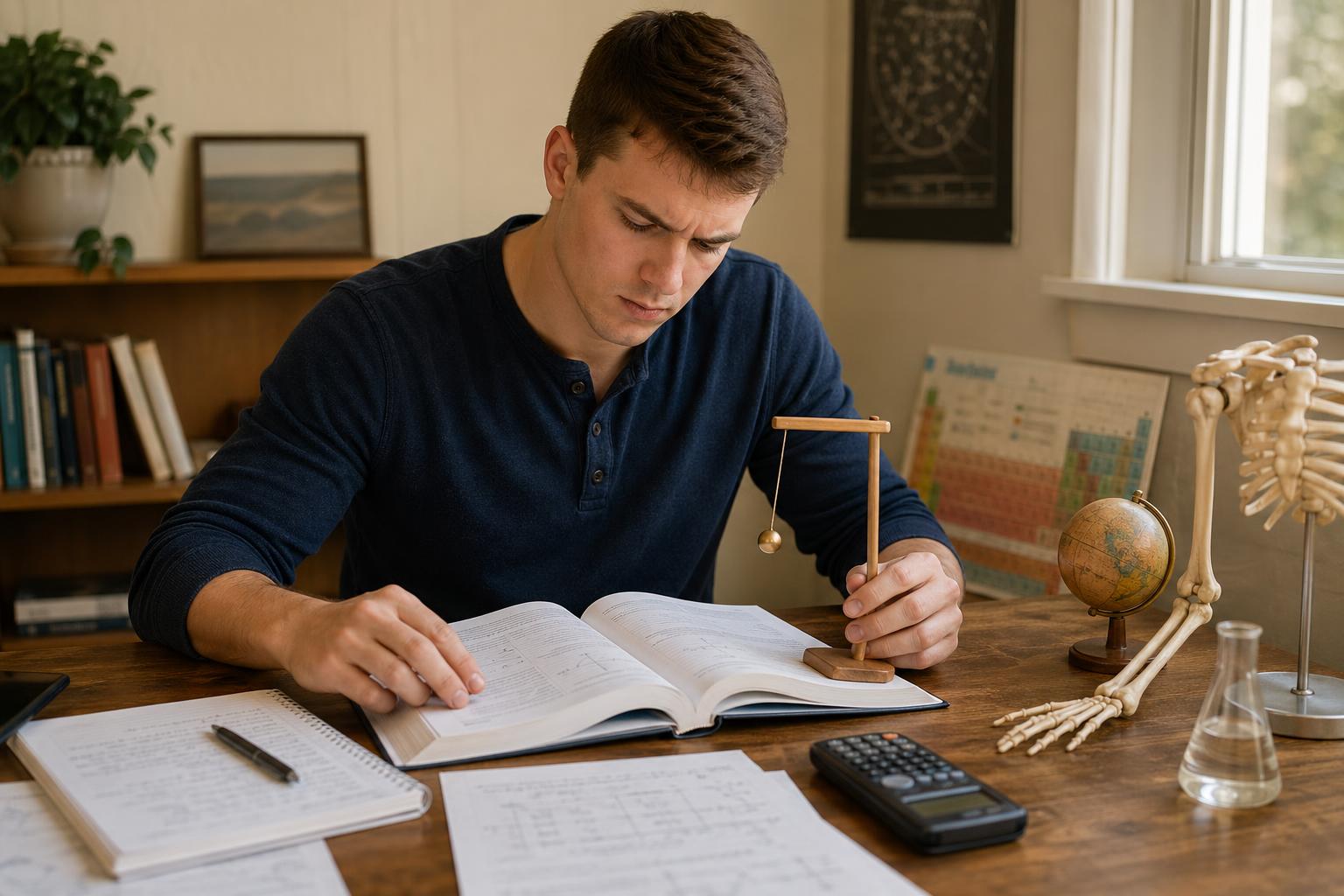
General Science doesn't count toward your AFQT. So why study it?
Because GS feeds into 12+ composite line scores across every branch of the military. Composite line scores are the formulas that determine which specific job you qualify for. Your AFQT gets you through the door. Your composites determine which job you walk into. A low GS score won't disqualify you from serving, but it will lock you out of the highest-paying, most competitive career fields: Combat Medic, avionics technician, electronics repair, nuclear engineering.
These 10 ASVAB general science tips cover the exact content that appears on the subtest, how to memorize it fast, and how to pace yourself through 16 questions in 8 minutes. The GS subtest spans three domains: life science, earth and space science, and physical science. The testable surface area is narrower than most people think. With 2-4 questions per domain, breadth beats depth every time. On the adaptive CAT-ASVAB, early questions carry extra weight, so knowing the high-frequency facts cold gives you an edge from question one.
Targeting Combat Medic, avionics, or nuke? Get the GS-aware plan
Free 30-day study plan plus a 5-email crash course on AFQT, line scores, and the GS-heavy composites that gate the best jobs.
No spam. Unsubscribe any time.
1. Know Why GS Matters for Your Military Career
Your AFQT gets you into the military. Your composite line scores get you the job. GS is baked into the formulas that gate the most competitive MOSs, AFSCs, and ratings across all four branches.
Every point you gain on GS ripples across multiple composites at once. A 7-point improvement on GS could be the difference between qualifying for Navy Electronics Technician and missing the cutoff entirely. Because GS appears in several composite formulas simultaneously, that single 7-point gain might push you over the threshold for three or four different career fields. That makes GS one of the highest-leverage subtests for career options, even though it never touches your AFQT.
| Branch | Composite | Formula | Example Job | Min. Score |
|---|---|---|---|---|
| Army | EL (Electronics) | GS + AR + MK + EI | 68A Biomedical Equipment | EL 107 |
| Army | ST (Skilled Technical) | GS + VE + MK + MC | 68W Combat Medic | ST 101 |
| Army | GM (General Maintenance) | GS + AS + MK + EI | 12R Interior Electrician | GM 93 |
| Air Force | E (Electronics) | GS + AR + MK + EI | Avionics Tech | E 70 |
| Navy | EL (Electronics) | AR + MK + EI + GS | Electronics Technician (ET) | EL 222 |
| Navy | HM (Hospital) | GS + MK + VE | Hospital Corpsman | HM 156 |
| Marines | EL (Electronics) | GS + AR + MK + EI | Electronics Maintenance | EL 100 |
The tips below are ordered by test frequency. Start with the domains that show up most, and work your way through the list in order.
2. Master the Five Body Systems That Appear Most Often
The circulatory system alone accounts for roughly 12% of GS questions. Add four more systems and you have covered the bulk of life science on the test. You do not need to memorize all 11 body systems. These five dominate.
Draw each system from memory once. If you can sketch the heart's four chambers and label the blood flow, you own the most-tested topic on the GS subtest. Then try labeling the air pathway from trachea to alveoli. Two quick sketches cover the two highest-frequency systems.
3. Learn Cell Biology Basics in 15 Minutes
You do not need a biology degree. Fifteen minutes with the right facts covers every cell question the ASVAB throws at you. Cell biology questions are predictable: organelle functions, mitosis vs. meiosis, and DNA basics.
| Organelle | Function |
|---|---|
| Nucleus | DNA storage, control center of the cell |
| Mitochondria | Energy production (ATP), the “powerhouse” |
| Cell Membrane | Controls what enters and exits the cell |
| Ribosome | Builds proteins from amino acids |
| Chloroplast | Photosynthesis (plant cells only) |
Mitosis vs. Meiosis. Mitosis divides body cells into 2 identical daughter cells with the full chromosome count (46 in humans). The four phases are prophase, metaphase, anaphase, and telophase (PMAT). Meiosis divides sex cells into 4 genetically unique cells with half the chromosomes (23). Mitosis handles growth and repair. Meiosis handles reproduction. If the question asks about “genetic variation,” the answer is meiosis.
Plant vs. Animal Cells. Plant cells have cell walls, chloroplasts, and a large central vacuole. Animal cells have none of these three. Both share a nucleus, mitochondria, and cell membrane.
DNA Basics. DNA is organized into genes, which sit on chromosomes. Humans have 46 chromosomes (23 pairs). Base pairing rules: Adenine pairs with Thymine (A-T), Guanine pairs with Cytosine (G-C). DNA carries the genetic code. RNA reads that code and delivers instructions to ribosomes for protein assembly.
Ecology One-Liner. Food chains follow a pattern: producers (plants) are eaten by primary consumers (herbivores), which are eaten by secondary consumers (carnivores). Energy decreases at each level.
Can you name three differences between plant and animal cells? If yes, you have passed the cell biology portion of your review. If not, re-read the plant vs. animal paragraph above until you can list them without looking.
4. Understand Earth's Layers, Rocks, and Plate Tectonics
Earth science questions follow a pattern: they ask about layers, rocks, or plates. Master those three clusters and you have handled this entire domain. Earth science is the second-highest tested area on GS after life science.
Crust
5-70 km thick, rocky surface where we live
Mantle
~2,900 km thick, convection currents drive plate movement
Outer Core
Liquid iron and nickel, generates Earth's magnetic field
Inner Core
Solid iron and nickel, ~5,400 degrees Celsius
Three Rock Types. Igneous forms from cooled magma or lava (granite, basalt). Sedimentary forms from compressed layers over time (sandstone, limestone, shale). Metamorphic forms when existing rock transforms under heat and pressure (marble from limestone, slate from shale). The rock cycle connects all three: any rock type can become any other through the right process.
Weathering vs. Erosion. Weathering breaks rock down in place (freeze-thaw cycles, acid rain, plant roots). Erosion moves the broken pieces to a new location (water, wind, glaciers). Both processes feed sedimentary rock formation.
Plate Tectonics. Earth's crust is divided into tectonic plates that float on the mantle. Three boundary types drive geological activity: convergent (plates collide, forming mountains or ocean trenches), divergent (plates separate, creating mid-ocean ridges and new crust), and transform (plates slide past each other, causing earthquakes). The San Andreas Fault is a transform boundary. Volcanoes cluster at convergent boundaries and along mid-ocean ridges. All continents were once joined as the supercontinent Pangaea.
Think of Earth's layers like a nesting doll. Crust wraps mantle, mantle wraps outer core, outer core wraps inner core. Temperature and pressure increase as you go deeper.
5. Memorize Atmosphere Layers and the Water Cycle
This is your easiest win on the GS subtest. Atmosphere and water cycle questions are pure recall. No math, no problem-solving. Memorize the facts and collect free points.
Troposphere (0-12 km)
Where weather happens, where jets fly
Stratosphere (12-50 km)
Contains the ozone layer, absorbs UV radiation
Mesosphere (50-80 km)
Where meteors burn up
Thermosphere (80-700 km)
Where the ISS orbits, auroras occur
Exosphere (700+ km)
Fades into outer space, GPS satellites orbit here
Atmosphere Composition. Nitrogen makes up 78% of the atmosphere. Oxygen is 21%. The remaining 1% includes argon, carbon dioxide, and trace gases. This is one of the most frequently tested ASVAB general science facts. The nitrogen-oxygen split is the single most common atmosphere question, so commit those two numbers to memory.
Weather Basics. Cold fronts form when cold air pushes under warm air, producing thunderstorms and sharp temperature drops. Warm fronts form when warm air rides over cold air, producing steady rain. Three cloud types to know: cumulus (puffy, fair weather), stratus (flat layers, overcast), and cumulonimbus (tall storm clouds, heavy rain and lightning).
Water Cycle. Evaporation (liquid to gas, driven by solar energy) > Condensation (gas to liquid, forms clouds) > Precipitation (falls as rain, snow, sleet, or hail) > Collection (runoff flows into oceans, rivers, and lakes). Transpiration is the release of water vapor by plants, feeding back into the cycle. Some precipitation seeps underground to become groundwater, which feeds wells and springs.
Five layers, four cycle stages, two percentages, three cloud types. That is 14 facts total. You can memorize them on one index card tonight.
6. Study the Solar System and Basic Astronomy
The ASVAB is not testing you on black holes or dark matter. It is asking whether you know the eight planets in order and a handful of facts about each. This is another domain where memorization pays off fast.
| Planet | Type | Key Fact |
|---|---|---|
| Mercury | Rocky | Closest to the Sun, no atmosphere |
| Venus | Rocky | Hottest planet (greenhouse effect) |
| Earth | Rocky | Only planet with known life |
| Mars | Rocky | Red color from iron oxide |
| Jupiter | Gas giant | Largest planet in the solar system |
| Saturn | Gas giant | Famous ring system |
| Uranus | Ice giant | Extreme axial tilt (rotates on its side) |
| Neptune | Ice giant | Farthest planet from the Sun |
Inner vs. Outer. The inner four planets (Mercury through Mars) are rocky and terrestrial. The outer four (Jupiter through Neptune) are gas or ice giants. The asteroid belt separates the two groups. Asteroids are rocky. Comets are icy and develop tails when they approach the Sun.
The Sun. The Sun is a main-sequence star that produces energy through nuclear fusion (hydrogen fusing into helium). It contains 99.8% of the solar system's mass. Light from the Sun takes about 8 minutes to reach Earth.
Eclipses. Solar eclipse: Moon passes between Earth and Sun, casting a shadow on Earth. Lunar eclipse: Earth passes between Sun and Moon, casting a shadow on the Moon. Moon phases cycle from new moon through waxing crescent, first quarter, full moon, waning, and back. A full cycle takes about 29.5 days.
Name the planets in order, then name the four rocky ones. If you can do both in under 10 seconds, move on to the next tip.
7. Nail the Physics Fundamentals
GS physics questions do not require you to solve equations. They test whether you understand the concepts behind motion, energy, and forces. If you can explain Newton's three laws in plain English, you can handle every physics question on this subtest.
Force (in Newtons) = mass (in kg) x acceleration (in m/s2)
You will not calculate this on the GS subtest. But you need to understand the relationship: increasing mass or acceleration increases force.
Energy Types. Kinetic (motion), potential (stored, including gravitational and elastic), thermal (heat), electrical, and nuclear. The law of conservation of energy states that energy cannot be created or destroyed, only converted from one form to another. A roller coaster at the top of a hill has maximum potential energy. At the bottom, that potential energy has converted to kinetic energy.
Six Simple Machines. Lever, pulley, wheel and axle, inclined plane, wedge, and screw. All six reduce effort by increasing the distance over which force is applied. These physics concepts overlap with the Mechanical Comprehension subtest, so this knowledge does double duty.
A book sitting on a table: what law keeps it still? First law (inertia). What force pair exists? The book pushes down on the table, and the table pushes up on the book (third law).
8. Cover Chemistry Essentials: pH, Elements, and Reactions
Chemistry on the ASVAB is a mile wide and an inch deep. You do not need to balance equations or memorize the periodic table. You need to know what pH means, how atoms work, and what happens when matter changes state.
Atomic Structure. Protons are positive and sit in the nucleus (they define the element). Neutrons are neutral and also in the nucleus. Electrons are negative and orbit the nucleus. Atomic number = number of protons. Mass number = protons + neutrons. Isotopes are atoms of the same element with different neutron counts. Carbon-12 and Carbon-14 are both carbon, but with different mass numbers.
| pH Range | Classification | Examples |
|---|---|---|
| 0-2 | Strong acid | Stomach acid (~1.5), lemon juice (~2) |
| 3-6 | Weak acid | Vinegar (~3), coffee (~5) |
| 7 | Neutral | Pure water |
| 8-11 | Weak base | Baking soda (~9), ammonia (~11) |
| 12-14 | Strong base | Bleach (~13) |
States of Matter. Solid (fixed shape and volume) > Liquid (fixed volume, takes the shape of container) > Gas (fills entire container). Phase changes: melting (solid to liquid), evaporation (liquid to gas), condensation (gas to liquid), freezing (liquid to solid), sublimation (solid directly to gas, like dry ice).
Chemical vs. Physical Changes. A physical change alters form but not composition (ice melting, paper tearing). A chemical change produces a new substance (rust forming, wood burning). New color, gas bubbles, or heat signals a chemical change.
Periodic Table Basics. Rows are called periods. Columns are called groups. Group 1 elements are alkali metals (highly reactive). Group 18 elements are noble gases (inert, rarely react). Metals sit on the left side of the table. Nonmetals sit on the right.
If you remember that pH 7 is neutral, acids fall below, and bases rise above, you have handled the most common chemistry question on GS.
9. Use Mnemonics to Lock In Key Science Facts
You have covered six science domains across these ASVAB general science tips. Now lock them in with memory tools that stick. Screenshot this section. It is your pre-test study reference.
| Topic | Mnemonic | What It Covers |
|---|---|---|
| Planets | “My Very Educated Mother Just Served Us Nachos” | Mercury, Venus, Earth, Mars, Jupiter, Saturn, Uranus, Neptune |
| Taxonomy | “Dear King Philip Came Over For Good Soup” | Domain, Kingdom, Phylum, Class, Order, Family, Genus, Species |
| Atmosphere | “The Silly Monkeys Took Everything” | Troposphere, Stratosphere, Mesosphere, Thermosphere, Exosphere |
| Redox | “OIL RIG” | Oxidation Is Loss, Reduction Is Gain |
| Mitosis phases | “PMAT” | Prophase, Metaphase, Anaphase, Telophase |
| Mohs hardness | “Tall Girls Can Flirt And Other Queer Things Can Do” | Talc to Diamond, scale 1-10 |
How to use them. Read each mnemonic aloud three times. Then close the page and write them from memory. Test yourself again the next day. This is spaced repetition: reviewing at increasing intervals (1 day, 3 days, 1 week) instead of cramming everything the night before. Your brain encodes information more deeply when it has to actively retrieve it rather than passively re-read it.
Build your own. Make personal mnemonics for facts that will not stick. Personal ones are more memorable than borrowed ones because your brain already has emotional hooks attached to the words you chose. Flashcards also work well for this. Write the question on one side and the answer on the other. Shuffle the deck and drill daily.
Drill sequence. Start with the four core mnemonics (planets, taxonomy, atmosphere, redox). Once those are locked in, add PMAT and Mohs hardness. Six mnemonics total covers facts across all three GS domains.
10. Pace the GS Subtest and Build a 4-Week Study Plan
You know what to study. Now build the plan that gets it done in 4 weeks, and the pacing strategy that keeps you from running out of time on test day.
CAT-ASVAB Pacing. 16 questions in 8 minutes gives you 30 seconds per question. You cannot skip questions. You cannot go back. Early questions carry more weight because the adaptive algorithm adjusts difficulty based on your answers. If you are unsure, eliminate two answers and guess from the remaining options. Never leave time on the table.
P&P Pacing. 25 questions in 11 minutes gives you about 26 seconds per question. You can skip and return. Flag difficult questions, answer the easy ones first, then circle back with remaining time.
Week 1
Life science (body systems + cells), 30 min/day
Week 2
Earth and space science (layers, rocks, atmosphere, planets), 30 min/day
Week 3
Physical science (physics + chemistry), 30 min/day
Week 4
Review all domains + timed practice sets, 45 min/day
Study Method. Active recall beats re-reading. Quiz yourself. Draw diagrams from memory. Explain concepts out loud. Take a diagnostic practice test before you start studying so you know which domains need the most attention. Then revisit our ASVAB study guide to build a plan that targets your weak spots. During Week 4, simulate test conditions: set an 8-minute timer, answer 16 questions, and score yourself immediately.
Ready to see which jobs your scores unlock? Plug your subtest scores into our All-Branch ASVAB Calculator and find out which MOSs, AFSCs, and ratings you qualify for right now.
Frequently Asked Questions
Does General Science count toward your AFQT score?
No. The AFQT uses only Arithmetic Reasoning (AR), Math Knowledge (MK), Word Knowledge (WK), and Paragraph Comprehension (PC). General Science does not affect your AFQT percentile, which determines basic enlistment eligibility. GS only affects composite line scores, which determine which military jobs you can hold. For a full breakdown of how AFQT scoring works, see our ASVAB scores explained guide.
How many questions are on the ASVAB General Science section?
The CAT-ASVAB (computer version) has 16 GS questions with an 8-minute time limit. The paper-and-pencil version has 25 questions with 11 minutes. Both average roughly 30 seconds per question. For a complete subtest breakdown, check how many questions are on the ASVAB.
What subjects does ASVAB General Science cover?
GS tests three broad domains. Life science covers human body systems, cell biology, genetics, and ecology. Earth and space science covers geology, atmosphere layers, weather, and astronomy. Physical science covers physics (Newton's laws, energy, simple machines) and chemistry (atoms, pH, states of matter, the periodic table). See Tips 2 through 8 above for the specific facts tested in each domain.
What is a good General Science score on the ASVAB?
GS is reported as a standard score with a mean of 50. Scores above 60 are competitive for most technical composites. For high-demand jobs like Army 68W Combat Medic (ST 101+) or Air Force avionics careers (E 70+), aim for a GS score of 65 or higher. Use our All-Branch ASVAB Calculator to see how your GS score affects your composite totals.
How should I study for ASVAB General Science?
Focus on the highest-frequency topics first: human body systems (especially circulatory), Earth's layers and rock types, Newton's three laws, and the pH scale. Use mnemonics for memorization (see Tip 9) and active recall (self-quizzing) instead of re-reading notes. A 4-week plan rotating through one domain per week is the most effective approach. Our how to study for the ASVAB guide covers the full strategy.
Can you skip questions on the GS section?
On the CAT-ASVAB (computer version), no. You must answer each question before the next one appears, and you cannot go back. On the paper-and-pencil version, yes. You can skip and return within the time limit. Never leave a question blank. The ASVAB does not penalize wrong answers, so guessing after eliminating options gives you better odds than skipping.
See What Your Scores Unlock
Enter your 9 subtest scores and instantly see your AFQT, composite scores, and every job you qualify for.
Try the Free Calculator