ASVAB Paragraph Comprehension Tips: 9 Strategies That Actually Move Your Score
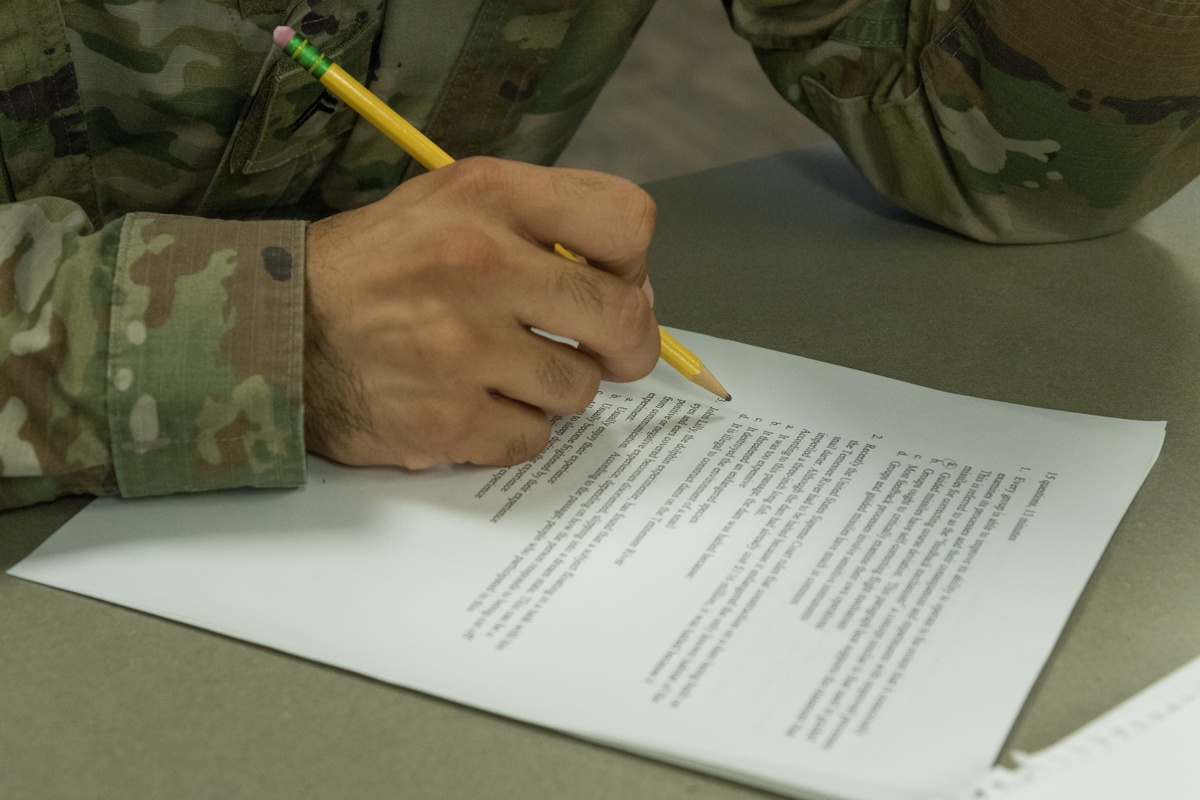
Most ASVAB prep advice for Paragraph Comprehension boils down to “read more books.” That's like telling someone to get stronger by “going to the gym more.” You need specific techniques, not vague encouragement.
Here's why ASVAB paragraph comprehension tips matter more than most test-takers realize: PC feeds directly into your Verbal Expression (VE) score, and VE is the only AFQT component that gets doubled. A 5-point VE improvement creates a 10-point AFQT jump. No other subtest gives you that kind of leverage.
Whether you're taking the CAT-ASVAB (11 questions, 22 minutes) or the paper-and-pencil version (15 questions, 13 minutes), these strategies work for both formats.
Below you'll find 9 strategies covering everything from reading the question before the passage to eliminating trap answers to type-specific tactics for each question format. The goal is to turn PC from a score you hope works out into a score you control. Already have scores? Plug them into the All-Branch ASVAB Calculator to see where you stand.
Step 1: Read the Question Before the Passage
Most people read the passage first, then the question, then the passage again. That's three reads. You only have time for two.
Reading the question first tells you HOW to read the passage. There are two reading modes, and the question type determines which one you need.
| Question Type | Reading Mode | What to Look For |
|---|---|---|
| Specific detail / factual | Scan | Keywords from the question |
| Main idea / author's purpose | Synthesize | First + last sentences |
| Vocabulary-in-context | Scan | Surrounding sentence only |
| Inference | Synthesize | What the passage implies but doesn't state |
| EXCEPT / NOT | Scan | Eliminate 3 that ARE stated |
Scan mode is for factual and detail questions. You're hunting for a specific piece of information. Skim until you find the keyword match, then read that sentence carefully.
Synthesize mode is for main idea and inference questions. You need the overall meaning, not a single fact. Read for the big picture, focusing on the first and last sentences.
Here's the process in practice. You open a question and see “According to the passage, what is the primary cause of...” That's a specific detail question, so you're in scan mode. Quick skim of the passage (10 seconds max) to get the topic. Read the question fully. Identify “primary cause” as your keyword. Do a targeted second read, scanning for that phrase or its synonyms. Two reads, not three.
Contrast that with a question like “What is the main idea of this passage?” Now you're in synthesize mode. Your 10-second skim focuses on the first and last sentences. You read for the big picture, ignoring individual facts. Same passage, completely different reading approach.
On the CAT-ASVAB, you can't skip questions or go back. Choosing the wrong reading mode wastes your limited time on a question you can't revisit. Getting the mode right on the first pass is the single biggest time-saver among all ASVAB paragraph comprehension tips.
Step 2: Learn the 5 Wrong-Answer Traps So You Can Eliminate on Sight
The ASVAB doesn't write random wrong answers. Test writers engineer every incorrect choice to look right in a specific way. Once you recognize the patterns, wrong answers become obvious.
1. Too Extreme. Absolute language like “always,” “never,” “all,” “none,” or “must.” Correct answers almost always use hedged language: “often,” “likely,” “frequently,” “may.” Think of it as the “never say never” rule. If an answer choice contains an absolute qualifier, it's probably wrong.
2. Too Narrow. A true detail pulled from the passage, but it doesn't answer the actual question. This is the go-to trap for main idea questions. The answer is factually correct and appears in the passage, which is exactly why people pick it. Ask yourself: does this cover the WHOLE passage or just one part?
3. Opposite. Reverses the passage's meaning. Often the test writers flip just one word. If the passage says a process “reduces” something, the trap answer says it “increases” it. Read every word.
4. Half Right, All Wrong. The first half matches the passage perfectly. The second half adds information the passage never stated. You stop reading after the first half because it sounds right. Don't. Read the entire answer choice before selecting it.
5. Definition Too Literal. Shows up on vocabulary-in-context questions. Gives you the dictionary definition instead of the passage-specific meaning. Example: “pressed” as “ironed” instead of the correct answer “forced.”
These five traps work fastest when you've already identified the question type from Step 1. If you know you're on a main idea question, you're specifically watching for “Too Narrow.” If you're on a vocab-in-context question, you're watching for “Definition Too Literal.” The reading mode tells you which trap to expect.
Step 3: Crack Specific Detail Questions by Matching Keywords
Specific detail questions are free points. The passage states the answer directly. You don't need to interpret anything.
You'll recognize them by phrases like “According to the passage...”, “The passage states that...”, or “Which of the following is true about...”
The keyword-matching strategy:
- Read the question first (scan mode from Step 1).
- Identify one or two keywords from the question.
- Scan the passage for those keywords or close synonyms.
- Read the sentence containing the keywords plus one sentence before and after.
- Match to the answer choice that paraphrases the passage (not copies it word-for-word).
Here's a worked example. Suppose the passage discusses tire maintenance and states: “Steel-belted radials, when properly maintained, can last up to 60,000 miles.” The question asks: “According to the passage, how long can steel-belted radials last?” Your keywords are “steel-belted radials” and “last.” You scan, find the sentence, and the answer is “up to 60,000 miles.”
Now map the wrong answers to the trap types from Step 2. “Exactly 60,000 miles” is Too Extreme, since the passage says “up to.” “80,000 miles” is an Opposite/distortion of the stated number. A detail about a different tire type is Too Narrow, answering a question that wasn't asked. Recognizing these traps turns four choices into one.
Never use outside knowledge. You might know facts about the topic that go beyond what the passage says. Only passage-supported answers count.
Free PC Trap-Pattern Pack: triage card + drill set
One-page triage card, the 5 wrong-answer traps with kill moves, three worked passages, and a four-passage drill with answer key. Print it, drill it, take it to the test.
No spam. Unsubscribe any time.
Step 4: Solve Main Idea Questions with the First-and-Last Sentence Method
Main idea questions are where most people lose points. Not because the passage is hard, but because they pick an answer that's true but too specific.
You'll spot these with phrasing like “What is the main idea?”, “The author's primary purpose is to...”, “This passage is mainly about...”, or “The best title for this passage would be...”
Use the first-and-last sentence method:
- Read the first sentence of the passage.
- Read the last sentence of the passage.
- Ask: what topic connects both?
- That connection IS the main idea.
- Scan answer choices for the one that matches.
First sentence
Introduces the topic or claim
Last sentence
Reinforces or concludes the point
Connection between them
The main idea
This works because ASVAB passages are short, usually one to two paragraphs. Writers state their point at the beginning and reinforce it at the end. The middle sentences are supporting details.
Take a passage about coin collecting where the first sentence mentions the history of coin theft in museums and the last sentence discusses modern security measures for rare collections. The connection? Protecting valuable coins. An answer about “a specific 1804 silver dollar stolen in 1967” is a detail from the middle. True, but Too Narrow.
“Main idea” and “author's purpose” use the same method with a different lens. Main idea = what the passage is about. Author's purpose = why the author wrote it (to inform, to persuade, to explain). Read for “what” on main idea questions. Read for “why” on author's purpose questions.
Step 5: Decode Vocabulary-in-Context Questions Using the IDEAS Framework
Vocabulary-in-context questions aren't vocabulary tests. They're context-reading tests. You don't need a bigger vocabulary. You need to read the surrounding sentences.
These questions look like: “As used in the passage, the word ___ most nearly means...” or “The word ___ in line X refers to...”
The IDEAS framework gives you five types of context clues to look for:
| Clue Type | Signal | Example |
|---|---|---|
| Inference | Implied by the situation | “pressed into service” = forced (not ironed) |
| Definition | Defined with “is,” “means,” commas | “Assembling, or putting together, the ingredients...” |
| Example | Examples clarify meaning | “Noxious gases, such as carbon monoxide...” |
| Antonym | Contrast with “but,” “however,” “unlike” | “Unlike the fragile vase, the bowl was sturdy” |
| Synonym | Restatement with “or,” “also known as” | “The arid, or dry, climate...” |
The strategy, step by step:
- Cover the answer choices so they don't influence you.
- Re-read the sentence with a mental blank where the word is.
- Fill in your own word that fits the blank.
- Uncover the choices and match to the closest one.
- Test your pick by substituting it back into the sentence. Does the sentence still make sense? Keep it. Does it break the meaning? Try another choice.
Worked example: A baking passage reads “Assembling the ingredients is the first step.” Cover the choices. The blank version: “___ the ingredients is the first step.” Your word: “putting together” or “gathering.” Uncover the choices. Match to “putting together.” Substitute back in: “Putting together the ingredients is the first step.” The meaning holds. That's your answer.
Step 6: Answer Inference Questions by Eliminating What the Passage Contradicts
Inference questions are where most people panic. The answer isn't stated in the passage, so it feels like guessing. It's not guessing. It's elimination.
You'll see phrasing like “It can be inferred...”, “The author would most likely agree...”, or “Based on the passage, which is probably true?”
Use the inference elimination method:
- Read the question (synthesize mode from Step 1).
- Read the full passage for overall meaning.
- For each answer choice, ask: “Does the passage contradict this?” If yes, eliminate it.
- For the remaining choices, ask: “Does the passage support this, even indirectly?” The supported one wins.
The key rule: a correct inference is ALWAYS supported by passage evidence. If you can't point to a specific sentence or combination of sentences that supports the answer, it's outside knowledge, not an inference.
Worked example: A passage about boiler technicians describes their training requirements and safety protocols. Choice A says “boiler technicians require no formal training.” Sentence 2 mentions a certification program. Contradicted. Eliminate. Choice C says “boiler work is the most dangerous trade.” The passage never compares it to other trades. Not supported. Eliminate. Choice D says “safety training is a significant part of becoming a boiler technician.” Sentences 1 and 3 together establish that training includes extensive safety protocols. Supported. Correct.
Watch for the EXCEPT/NOT variant. These flip the logic: three answers ARE inferable, and one is NOT. Use the same elimination method, but mark answers as “supported” instead of “contradicted.” The one without support is your answer.
Read the word “EXCEPT” or “NOT” twice before answering. Missing the negation is the number one mistake on these questions.
Step 7: Manage Your Time Differently on CAT vs. Paper-and-Pencil
The ASVAB comes in two formats with completely different time pressures. Using the wrong pacing strategy costs points even if you know the material. These ASVAB paragraph comprehension tips only work if you have enough time to apply them, so pacing is non-negotiable.
| CAT-ASVAB | Paper-and-Pencil | |
|---|---|---|
| Questions | 11 | 15 |
| Time | 22 minutes | 13 minutes |
| Per question | ~2 min | ~51 sec |
| Can skip? | No | Yes |
| Adaptive? | Yes | No |
CAT strategy: The First Five Rule.
On the CAT-ASVAB, the first five questions carry disproportionate weight. The adaptive algorithm uses your early answers to determine your ability level. Get the first five right, and the algorithm locks you into harder questions worth more points.
Spend up to 3 minutes each on the first 5 questions. Be deliberate. Use every strategy from Steps 1 through 6. Then budget the remaining 7 minutes across the last 6 questions, roughly 70 seconds each.
First 5 questions
Up to 3 min each (15 min total)
Remaining 6 questions
~70 sec each (7 min total)
Total
22 minutes
You cannot go back on CAT. Every answer is final. No skipping. This is why the reading-mode decision from Step 1 matters so much. One wrong reading mode on an early question can cascade.
Paper-and-pencil strategy: The Two-Pass Method.
With 51 seconds per question, you can't afford to get stuck. Pass 1: answer every question you can in under 45 seconds. Flag anything that takes longer. Pass 2: return to flagged questions with your remaining time.
You CAN skip and return on paper-and-pencil. Use this advantage.
One rule applies to both formats: you can always reference the passage while answering. Never answer from memory. Always go back and verify.
Step 8: Build Long-Term PC Skills Between Now and Test Day
Steps 1 through 7 are test-day strategies you can apply immediately. This step is for the weeks leading up to your test when you have time to build the underlying skill.
Daily reading practice (15–20 minutes).
Read at your current level. Don't force yourself through dense academic papers. Good sources: news articles, Wikipedia entries, science magazines, anything with short 1-2 paragraph sections that mirror the ASVAB format.
After each article, close it and summarize the main idea in one sentence. This trains synthesize mode from Step 1 without requiring a practice test.
Active reading technique.
After every paragraph, pause and ask: “What was the point of that paragraph?” This forces your brain to process meaning in real time instead of letting your eyes slide across words.
Vocabulary building. Don't memorize word lists. When you hit an unknown word while reading, use the IDEAS framework from Step 5 to figure it out from context. That's the exact skill the test measures.
Timeline. Two or more weeks out: daily reading plus weekly practice tests. One week out: focus on the ASVAB paragraph comprehension tips in Steps 1–7 and do a full timed practice section. Day before: review the 5 trap types from Step 2, then rest.
Step 9: See How PC Affects Your AFQT and Branch Qualification
PC doesn't just affect one score. It cascades through your entire ASVAB results because of how the scoring formulas work. Understanding this connection is the reason these ASVAB paragraph comprehension tips focus so heavily on PC as a leverage point.
AFQT = 2(VE) + AR + MK
VE is the ONLY component that gets doubled.
5-point VE gain = 10-point AFQT gain.
What this means in real numbers: if your AFQT is sitting at 28, you're below the Army's minimum of 31. Improving PC alone could push you over the line. If you're at 33, you qualify for Army, Navy, and Marines, but you're locked out of the Air Force (36 minimum). A few more PC points could open two additional branches.
| Branch | Minimum AFQT |
|---|---|
| Army | 31 |
| Navy | 31 |
| Marines | 31 |
| Air Force | 36 |
| Space Force | 36 |
| Coast Guard | 32 |
Beyond the AFQT, PC feeds into composite line scores like Clerical (CL) and General Technical (GT) that determine which specific jobs you qualify for. Higher composites mean more MOS options (Army/Marines), more AFSC options (Air Force/Space Force), and more rating options (Navy/Coast Guard). More options mean more bargaining power with your recruiter when it's time to pick your job.
FAQ
How many paragraph comprehension questions are on the ASVAB?
It depends on the format. The CAT-ASVAB (computerized version taken at MEPS) has 11 Paragraph Comprehension questions with a 22-minute time limit. The paper-and-pencil version has 15 questions with a 13-minute time limit. Either way, each question is tied to a short passage of one to two paragraphs. Your recruiter can tell you which format you'll take.
What are the question types on the ASVAB paragraph comprehension section?
There are five main types: specific detail (asks about a fact stated in the passage), main idea (asks what the passage is about overall), vocabulary-in-context (asks what a word means as used in the passage), inference (asks what the passage implies but doesn't directly state), and EXCEPT/NOT (asks you to identify the one answer that ISN'T supported). Each type requires a different reading strategy, covered in Steps 3 through 6 above.
How does paragraph comprehension affect my AFQT score?
PC combines with Word Knowledge (WK) to form your Verbal Expression (VE) score. VE is the only AFQT component that gets doubled in the formula: AFQT = 2(VE) + AR + MK. That means a 5-point improvement in VE translates to a 10-point AFQT jump. No other subtest gives you that kind of scoring leverage.
Can I go back and change answers on the ASVAB paragraph comprehension section?
Only on the paper-and-pencil version. The P&P ASVAB lets you skip questions and return to them within the time limit. The CAT-ASVAB does not. Once you submit an answer on the CAT, it's final. You cannot go back, skip ahead, or change a previous response. This is why the First Five Rule from Step 7 matters: invest extra time in early questions when the stakes are highest.
How can I improve my ASVAB paragraph comprehension score quickly?
The fastest gains come from two immediate changes: reading the question before the passage (Step 1) so you know what to look for, and learning the 5 wrong-answer trap patterns (Step 2) so you can eliminate on sight. These work on test day without weeks of preparation. For pacing, learn the First Five Rule for CAT or the Two-Pass Method for P&P (Step 7). For sustained improvement, add the daily reading practice from Step 8. Even one to two weeks of 15-minute daily sessions builds the comprehension speed that PC questions demand.
Is paragraph comprehension the same as reading comprehension on the ASVAB?
Yes. The official subtest name is “Paragraph Comprehension,” but it tests standard reading comprehension skills: understanding main ideas, finding details, interpreting vocabulary in context, and drawing inferences. The ASVAB doesn't have a separate “reading comprehension” section. If you see that term in study guides, they're referring to Paragraph Comprehension.
The appearance of U.S. Department of Defense (DoD) visual information does not imply or constitute DoD endorsement.
Free PC Trap-Pattern Pack: triage card + drill set
One-page triage card, the 5 wrong-answer traps with kill moves, three worked passages, and a four-passage drill with answer key. Print it, drill it, take it to the test.
No spam. Unsubscribe any time.
See What Your Scores Unlock
Enter your 9 subtest scores and instantly see your AFQT, composite scores, and every job you qualify for.
Try the Free Calculator