10 ASVAB Math Tips That Actually Raise Your Score
Your AFQT score decides whether you enlist or go home. Here's the formula:
AFQT = 2VE + AR + MK
Two of those four inputs, Arithmetic Reasoning and Mathematics Knowledge, are pure math. Math controls half your enlistment eligibility, half your job options, and half your shot at a signing bonus.
AR and MK aren't the same test. AR gives you word problems and 2.5 minutes per question. MK gives you straight math and 75 seconds per question. They demand different knowledge, different speed, and different strategies.
These 10 tips cover test structure, in-test strategy, and study planning. Every tip is specific to the ASVAB, not generic “study harder” advice.
Plug your current scores into our All-Branch ASVAB Calculator before you start studying. Knowing your baseline makes everything else in this guide more useful.
1. Know Why AR and MK Matter More Than You Think
Every point you gain on AR or MK adds one raw point to your AFQT, a direct 1:1 relationship. Raise AR by 5 and MK by 5, and your AFQT jumps by 10.
But the AFQT is just the starting point. AR and MK also feed into branch-specific composite scores that determine which jobs you qualify for.
AR appears in 5 of 9 Army composite scores
MK appears in 4 of 9
GT 110+ required for cyber and intel jobs
The Army's General Technical (GT) score combines AR with Verbal Expression (WK and PC), then rescales the result. A GT of 110 or higher gates cyber and intelligence roles like 17C (Cyber Operations Specialist), some of the best-paying, most transferable jobs in the military. The Air Force General composite uses AR + VE. The Navy's BEE composite double-weights MK, making it critical for nuclear and electronics ratings.
Scoring 50+ on the AFQT opens most Military Occupational Specialties across all branches, plus enlistment bonus eligibility, up to $20,000 or more in signing bonuses and up to $50,000 in student loan repayment. The difference between a 45 and a 55 AFQT can be worth tens of thousands of dollars before you ship to basic.
For a deeper breakdown, see our guide to ASVAB scores explained.
2. Understand What's Actually on AR vs. MK
AR and MK have different content, different formats, and very different time pressure. Studying for one does not prepare you for the other.
| AR | MK | |
|---|---|---|
| Questions | 16 | 16 |
| Time | 39 min (~2.5 min/q) | 20 min (~75 sec/q) |
| Format | Word problems | Direct math |
| Top topics | Ratios, D=RT, percentages | Algebra (~55%), Geometry (~45%) |
Arithmetic Reasoning is all word problems. You read a scenario, identify what's being asked, then set up and solve an equation. Most common topics: ratios and proportions, distance-rate-time, percentages, fractions, geometry word problems, unit conversions, and basic probability. At about 2 minutes 26 seconds per question, the pace is generous, if you have a method for breaking down word problems (see Tip 3).
Mathematics Knowledge is direct math, no stories, no scenarios. You see an equation or geometric figure and solve it. Content splits roughly 55% algebra (equations, inequalities, exponents, quadratics) and 45% geometry (polygons are the most tested topic, coordinate geometry the least). Formulas are NOT provided. Every formula you need must come from memory.
For a complete study approach to both subtests, check out our ASVAB study guide.
3. Use the 3-Step Method for Every AR Word Problem
Most AR mistakes happen before anyone does any math. People read a word problem, latch onto the numbers, and start calculating before they understand what's being asked.
The 3-Step Method
- Step 1, WANT: What is the question actually asking for? Identify the unknown and its unit.
- Step 2, HAVE: What numbers and relationships are given? Write them down with units.
- Step 3, CONNECT: Which operation or formula links HAVE to WANT? Set up the equation, then solve.
Worked example: “A truck uses 12 gallons of gas to travel 180 miles. How many gallons will it need to travel 300 miles?”
WANT: Gallons needed for 300 miles.
HAVE: 12 gallons per 180 miles. Trip distance is 300 miles.
CONNECT: Ratio/proportion. Set up: 12/180 = x/300. Cross-multiply: 180x = 3,600. Divide: x = 20 gallons.
That took about 30 seconds once the setup was clear. Without the method, people often multiply 12 x 300, divide by random numbers, or confuse which value goes where in the proportion.
AR word problems are designed with extra information, tricky phrasing, and multiple possible operations. The test writers know most mistakes come from misreading the problem, not from inability to do the math. Step 1 neutralizes that.
4. Learn the Signal Words That Trick You on AR
Word problems translate English into math. The ASVAB uses specific phrases that map to specific operations, and some are deliberately counterintuitive.
The biggest trap: “less than” reverses the order. “Five less than x” means x − 5, not 5 − x. This single pattern accounts for a huge number of wrong answers on AR.
| Signal Word/Phrase | Operation | Example | Translation |
|---|---|---|---|
| “more than”, “increased by”, “sum of” | Addition | “8 more than y” | y + 8 |
| “less than”, “decreased by”, “fewer than” | Subtraction (REVERSED) | “5 less than x” | x − 5 |
| “of” (with fractions/percents) | Multiplication | “1/3 of 60” | (1/3) x 60 |
| “per”, “each”, “every” | Division (rate) | “miles per gallon” | miles / gallons |
| “is”, “was”, “equals” | Equals sign | “The result is 12” | = 12 |
A sentence using multiple signal words: “Three-fourths of a number, decreased by 10, is 50.” Translation: (3/4)x − 10 = 50. “Of” means multiply, “decreased by” means subtract, “is” means equals. If you can parse that sentence correctly, you can handle any AR phrasing.
During practice, circle the signal words in each problem before solving. After a few dozen problems, you'll spot them instantly.
5. Memorize This MK Formula List (They Won't Give It to You)
The ASVAB does not provide a formula sheet, not for MK, not for AR, not for any section. Every formula you need must already be in your head.
Geometry
- Area of rectangle: A = lw
- Area of triangle: A = 1/2 bh
- Area of circle: A = πr²
- Circumference: C = 2πr
- Volume of rectangular solid: V = lwh
- Volume of cylinder: V = πr²h
- Pythagorean theorem: a² + b² = c²
- Perimeter of rectangle: P = 2l + 2w
Algebra
- Slope: m = (y₂ − y₁) / (x₂ − x₁)
- Slope-intercept: y = mx + b
- Quadratic formula: x = (−b ± √(b² − 4ac)) / 2a
- Order of operations: PEMDAS
- Exponent rules: x^a × x^b = x^(a+b) | (x^a)^b = x^(ab)
You also need fraction-decimal conversions memorized cold. These appear in both AR and MK, and converting in your head saves 15 to 20 seconds per problem.
| Fraction | Decimal |
|---|---|
| 1/2 | 0.5 |
| 1/3 | 0.333 |
| 1/4 | 0.25 |
| 1/5 | 0.2 |
| 1/8 | 0.125 |
| 3/4 | 0.75 |
| 2/3 | 0.667 |
How to memorize these: Make flashcards with the formula on one side and the name on the other. Test yourself daily starting at least three weeks before your test date. Each day, write every formula from memory on a blank sheet before checking your cards. By test day, writing the entire list should take under two minutes.
Week one: geometry formulas. Week two: add algebra. Week three: add fraction-decimal conversions and start full recall drills. Spreading it out makes the recall stick.
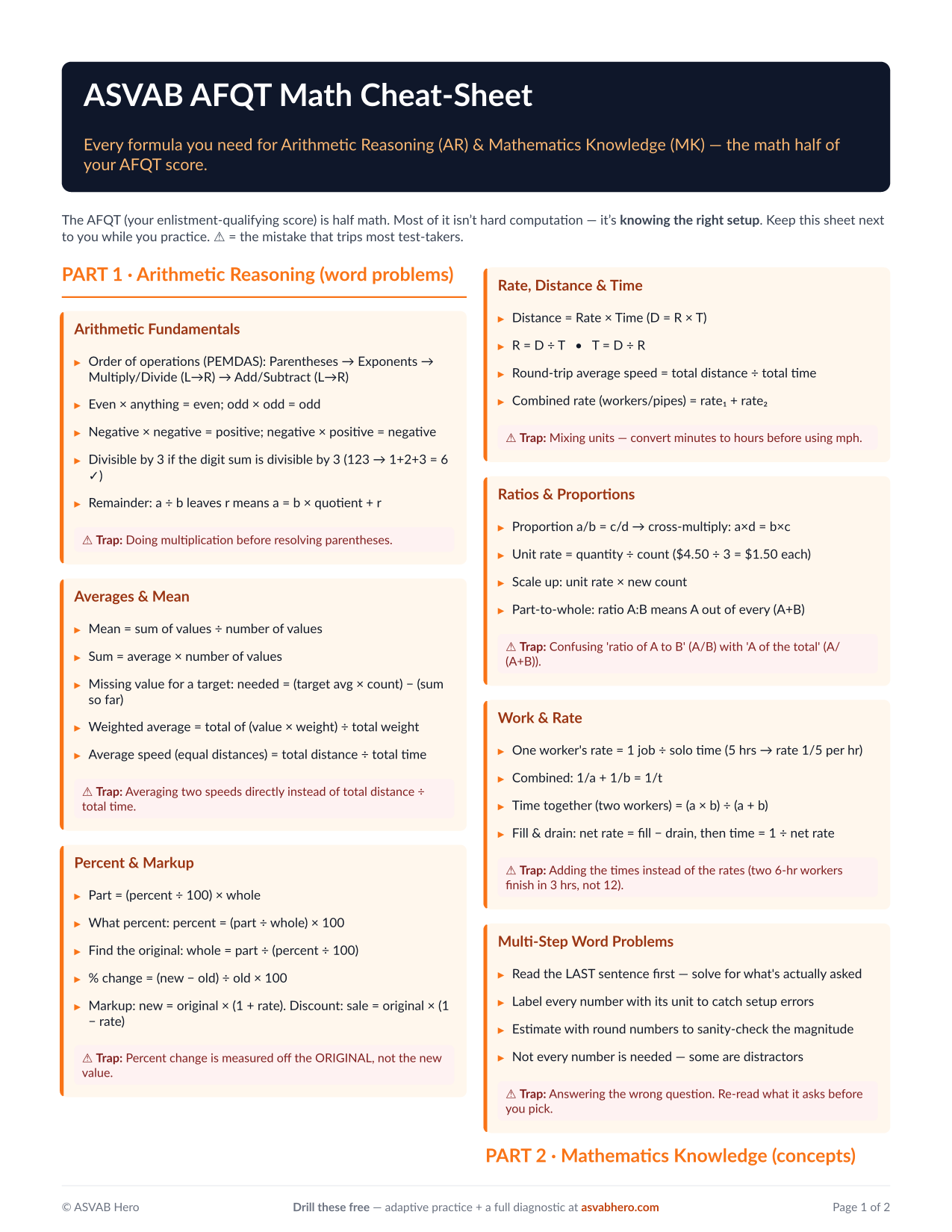
The AFQT Math Cheat-Sheet
Every formula for Arithmetic Reasoning and Mathematics Knowledge on two pages, the math half of your AFQT, in one place to keep next to you while you practice.
- All 14 AR and MK topics: the formula, the setup, and the trap that costs points.
- Built from the lessons thousands of test-takers use at ASVAB Hero.
- Instant PDF download. Print it and drill, no calculator needed.
No spam. Unsubscribe any time.
6. Build Mental Math Speed (No Calculator Allowed)
No calculator on any ASVAB section. Every multiplication, division, percentage, and fraction conversion happens in your head or on scratch paper. If your mental math is slow, you'll run out of time on MK regardless of whether you know the material.
Four techniques that cover most of what you'll need:
Technique 1: Distributive multiplication
4 x 53 = (4 x 50) + (4 x 3) = 200 + 12 = 212
Break awkward multiplications into round numbers plus a small remainder.
Technique 2: Halving for division by 4
340 / 4 = (340 / 2) / 2 = 170 / 2 = 85
Dividing by 4 is just halving twice.
Technique 3: Build percentages from 10%
10% = move the decimal left one place. 20% = double it. 5% = halve it. 15% = 10% + 5%.
15% of 240 → 10% is 24, 5% is 12, total is 36
Technique 4: Estimation to eliminate choices
Round the numbers, estimate the answer, and cross out obviously wrong choices before solving exactly. If you estimate ~80 and the choices are 42, 78, 156, and 312, you only need to verify one answer.
Build this skill with daily repetition. Spend 10 minutes a day doing arithmetic without a calculator. Calculate tips in your head, estimate grocery totals, multiply license plate numbers. After two weeks, you'll notice a real difference in how fast you work through ASVAB problems.
7. Back-Solve When the Algebra Gets Ugly
The ASVAB is multiple choice. The correct answer is already on the screen. When a problem looks complicated, plug the answer choices back into the original equation instead of solving forward through messy algebra.
Example: “What value of x satisfies 3x² − 12 = 0?”
Choices: A) 1 B) 2 C) 3 D) 4
Plug in B: 3(2²) − 12 = 3(4) − 12 = 12 − 12 = 0
Done in 10 seconds.
Solving algebraically requires adding 12, dividing by 3, then taking a square root. Not hard, but slower. On MK's 75-second clock, those saved seconds compound.
When to back-solve: Quadratics, problems with fractions or nested expressions, anything where you don't immediately see a clean algebraic path.
When NOT to back-solve: Simple linear equations. If the problem is 2x + 5 = 15, just solve it directly.
Start with choice B or C (the middle values). If the result is too high, try lower. If too low, go higher. You'll usually find the answer in one or two attempts.
8. Slow Down on the First 5 CAT-ASVAB Questions
If you're taking the ASVAB at a Military Entrance Processing Station (MEPS), you're on the CAT-ASVAB, the computer-adaptive version. This changes how scoring works.
How CAT-ASVAB Scoring Works
- Test starts at medium difficulty
- Correct answer → next question is harder (higher score ceiling)
- Wrong answer → next question is easier (lower score ceiling)
- First 5 questions carry the highest scoring weight
- You CANNOT go back and change answers
Not all questions count equally. Getting questions 1 through 5 right pushes you into a harder bracket where even mediocre performance on later questions still yields a strong score. Getting those early questions wrong drops you into an easier bracket where perfect performance later can't fully recover your score.
AR pacing (39 min, 16 questions): Spend 3 to 4 minutes on each of the first 5 questions. That uses about 18 minutes, leaving 21 minutes for the remaining 11, still nearly 2 minutes each.
MK pacing (20 min, 16 questions): Spend about 90 seconds on each of the first 5 questions. That's 7.5 minutes, leaving 12.5 minutes for the remaining 11, over a minute each. Tight but workable if your formula recall is solid.
Read the first five questions carefully. Double-check your work before clicking next. Once you submit, there's no going back.
9. Pace AR and MK on Completely Different Clocks
People study AR and MK together, practice them together, and walk into the test treating them like the same section. The time pressure is drastically different.
AR: 39 min / 16 questions = 2 min 26 sec each
MK: 20 min / 16 questions = 1 min 15 sec each
MK gives you roughly HALF the time per question
AR pacing: use your time. Two and a half minutes per question is enough to read the problem twice, set up your equation, solve, and check. Most AR mistakes come from misreading the problem. If you're finishing AR with 10 minutes to spare, you're probably rushing and making avoidable errors.
MK pacing: recognize and execute. Seventy-five seconds is not enough time to figure out a solution from scratch. You need to see a question and immediately know which formula or method applies. If you don't know the approach within 15 seconds, make your best educated guess and move on. Burning 2 minutes on one MK question steals time from two or three others.
Always time yourself during practice: 75 seconds per MK question, 2.5 minutes per AR question. Train your internal clock so on test day you instinctively know when you're spending too long. Head to our practice tests for timed practice sets.
10. Follow a 5-Week Study Plan With Real Score Targets
These tips only work with consistent practice. The good news: you don't need months. Data from the Army's Academic Skills Development Program shows an average 17-point AFQT improvement in 3 weeks of structured study. One documented case went from a 38 to a 72 AFQT (a 34-point gain). Across the program, 43 to 50% of participants moved up at least one AFQT category.
| Week | Focus | Daily Time | Goal |
|---|---|---|---|
| 1 | Diagnostic test + identify weak areas | 30 min | Know your baseline AR and MK scores |
| 2 | Formula memorization + mental math drills | 45 min | Recall all MK formulas from memory |
| 3 | AR word problems using 3-step method | 45 min | Complete 15 AR problems under time |
| 4 | MK timed practice (75 sec/question) | 45 min | Complete 16 MK problems in 20 min |
| 5 | Full timed practice tests + error review | 60 min | Consistent improvement on practice scores |
Week 1 is diagnostic. Take a full-length practice test and identify where you're losing points. Slow on MK? Missing AR setups? Forgetting geometry formulas? Your weak spots dictate where to focus. Weeks 2 through 4 target specific skills in sequence: you can't do timed MK practice if you haven't memorized the formulas yet. Week 5 puts it all together with full timed sections and error analysis.
Realistic expectations: 4 to 6 weeks of structured daily study typically yields a 10 to 20 point AFQT improvement. Starting below 50, you'll likely see bigger gains because foundational skills have the steepest improvement curve. Already scoring in the 60s or 70s, gains are smaller but still meaningful for composite scores and job qualification.
Start with a practice test to set your baseline. Then check your scores against job requirements with the All-Branch ASVAB Calculator. Knowing exactly how many points you need, and for which subtests, makes your study time dramatically more efficient.
For the complete study approach beyond just math, see the full ASVAB study guide.
ASVAB Math Tips: Frequently Asked Questions
Is the ASVAB math hard?
The content is high school level. AR covers word problems through basic algebra, including ratios, percentages, and distance-rate-time. MK covers algebra and geometry, including equations, formulas, and exponent rules. If you passed Algebra 1 and basic geometry, you have the foundation. The real challenge is speed (especially MK's 75-second pace) and the no-calculator rule.
What math is on the ASVAB?
Two subtests: Arithmetic Reasoning (16 word problems covering ratios, percentages, distance-rate-time, fractions, and unit conversions) and Mathematics Knowledge (16 direct math problems split roughly 55% algebra and 45% geometry). Both are multiple choice. Formulas are not provided.
How can I improve my ASVAB math score fast?
Focus on formula memorization for MK and the 3-step word problem method for AR first. These cover the most ground in the least time. Then build mental math speed and practice under timed conditions. Three to five weeks of focused daily practice typically yields a 10 to 20 point AFQT improvement.
Can I use a calculator on the ASVAB?
No. No calculator on any ASVAB section. Build mental math shortcuts (see Tip 6) and practice every problem by hand. If you're relying on a calculator during study sessions, you're not preparing for real test conditions.
What ASVAB math score do I need?
It depends on your branch and target job. Minimum AFQT for Army is 31 (with a diploma), Air Force is 36, Navy is 31, Marines is 32. Scoring 50+ opens most jobs across all branches and makes you eligible for enlistment bonuses. Use the calculator to check specific job requirements against your scores.
How is ASVAB math scored?
AR and MK each produce individual standard scores (mean around 50, standard deviation around 10). Both feed directly into your AFQT: AFQT = 2VE + AR + MK. Higher math scores also feed into branch-specific composite scores, like the Army's GT or the Navy's BEE, that determine which jobs you qualify for beyond basic enlistment.
The AFQT Math Cheat-Sheet
Every formula for Arithmetic Reasoning and Mathematics Knowledge on two pages, the math half of your AFQT, in one place to keep next to you while you practice.
- All 14 AR and MK topics: the formula, the setup, and the trap that costs points.
- Built from the lessons thousands of test-takers use at ASVAB Hero.
- Instant PDF download. Print it and drill, no calculator needed.
No spam. Unsubscribe any time.
See What Your Scores Unlock
Enter your 9 subtest scores and instantly see your AFQT, composite scores, and every job you qualify for.
Try the Free CalculatorPrefer paper? The new ASVAB math workbook is out
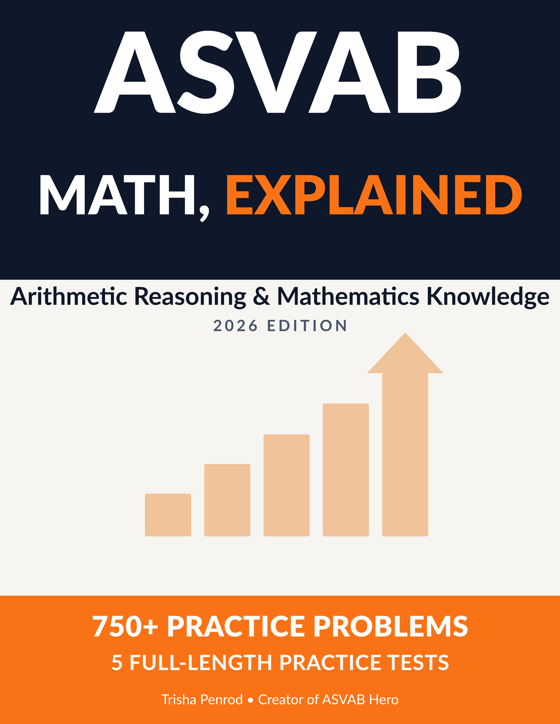
ASVAB Math, Explained covers the entire math half of the AFQT, Arithmetic Reasoning and Mathematics Knowledge, with every problem worked out in full. The offline, annotate-it companion to practicing here.
- 750+ worked practice problems and 5 full-length tests, the whole math half of the AFQT.
- Every problem solved step by step, so the math actually clicks.
- Arithmetic Reasoning and Mathematics Knowledge, in one workbook.